Bridging TradFi and DeFi through bond tokenization
Unlocking real yield with synthetic stablecoins.
"Every stock, every bond will be on one general ledger" — Larry Fink, BlackRock.
Evidentia is a decentralized finance protocol that enables users to mint local stablecoins (e.g., UAHe, eTRY, eVND) fully backed by tokenized government bonds, provided by collateral managers as ERC-1155 NFTs. Deployed on multiple blockchain networks, it serves institutional and retail clients in Eastern Europe, Latin America, and Southeast Asia, facilitating liquidity for bondholders and offering staking for yield generation. The platform integrates with decentralized and centralized exchanges, lending markets, and supports applications such as cross-border payments and e-commerce, maintaining stringent compliance and interoperability through LayerZero.
Evidentia Whitepaper v.1
Introduction
Bond's Platform is a decentralized finance (DeFi) protocol designed to bridge traditional financial instruments, such as government bonds, with the rapidly evolving world of decentralized ecosystems. Bond's Platform facilitates the tokenization of government bonds, enabling users to lock tokenized bonds (NFTs) as collateral to mint a synthetic stablecoin. The protocol enables the user to retain bond exposure while accessing liquidity via synthetic stablecoins, providing opportunities for yield generation through staking mechanisms.
This document details all layers of Bond's Platform's abstraction, covering both high-level user flows and the underlying mathematical framework governing bond tokenization, stablecoin minting, staking, and liquidation processes.
1. Bond Collateral Agreement (Off-Chain)
Prior to the on-chain tokenization of a bond, an off-chain Bond Collateral Agreement is established between the user and an authorized institution (Collateral Manager).
Process:
Step 1: Bond Submission and Agreement
- A user acquires a bond from the traditional bond market.
- The user signs an off-chain Bond Collateral Agreement with the Collateral Manager, submitting the bond's details (e.g., principal, APY, coupon dates, expiration date) to the authorized institution, without transferring ownership or possession of the bond.
- The Collateral Manager validates the bond's eligibility based on the provided details typically through a manual verification process.
Step 2: Creation of an Off-Chain Agreement
- Upon successful validation, the Collateral Manager records a reference to the bond in an off-chain database and assigns a unique ID, which will be used in the tokenization process.
The bond tokenization is performed by the authorized institution (Collateral Manager), which is granted permission to mint tokens from the designated Bond Holder address. Evidentia does not tokenize the bonds or handle the collateral agreement; these responsibilities are managed entirely by the Collateral Manager.
2. Bond Tokenization and Loan Issuance
2.1 Bond Tokenization
Each bond is tokenized into an ERC-1155 NFT, representing the bond's attributes, including maturity date, coupon rate, and market price. The tokenized bonds can then be locked as collateral in smart contracts to mint synthetic stablecoins.
2.2 Loan Issuance
Loans are issued based on the discounted cash flow of the bond (which is always at least nominal and last coupon) minus a safety fee. Importantly, on the first stage term coupons within maturity period are not accounted as well as change in market value of the bond. The maximum loan amount is based on the bond's nominal value with last coupon minus safety fee and discounted for platform APY till maturity. This version of the loan calculation is viable for short term bonds (up to 24 months) from the perspective of capital efficiency.
2.3 Loan Formula
Max Loan Amount (Initial Loan Cap):
Where:
- Nominal Value: Principal value of the bond.
- Coupon Rate: Percentage yield from last coupon.
- Safety Fee: Percentage reserved for risk management during liquidation, which ensures that the platform remains solvent.
2.4 Available Loan Amount Formula
As time progresses toward the bond's maturity the available loan amount is calculated based on the bond's remaining cash flow, adjusted for accrued interest and safety margins:
Where:
- Platform Daily APY: Daily interest rate applied by the platform.
- Days Remaining: Number of days left until maturity date.
2.5 Smart contract binary logarithm for calculating accruing compounding debt
Where:
- Dtotal,t is total protocol debt of the borrowers at the point of time t.
- T is time difference in seconds between calculation points.
- Tyear is the number of seconds in a year.
- Rprotocol is a protocol yield in percentage per year.
- Dtotal,t−1 is protocol debt at a previous point of time t−1.
For precise calculations the value of the binary logarithm log₂(Dtotal,t) is stored in a contract state in a form of unsigned 60.18-decimal fixed-point number from PRBMath Solidity library. Accruing debt Dtotal,t could be obtained by getting the binary exponent exp2(log₂(Dtotal,t)).
3. Staking Mechanism
The staking pool allows stablecoin holders to stake their coins and receive yield from the interest paid by borrowers on their loans. However, unlike previous models that assume all stablecoins are staked, this protocol accounts for real-world usage where borrowers use stablecoins for other needs, resulting in only a portion being staked.
3.1 Staking APY Formula
The staking APY is derived from the total interest accrued by borrowers, distributed among the stakers in the pool. The APY is inversely proportional to the total amount of stablecoins staked, meaning that the more stablecoins staked, the lower the APY for individual stakers.
Where:
- Total Interest Paid by Borrowers: The total amount of interest paid by all borrowers on their outstanding loans.
- Total Stablecoins Staked: The total number of stablecoins staked in the staking pool.
Example:
- Total Interest Paid by Borrowers: 1,200,000 stablecoins (based on 12% APY on loans)
- Scenario 1 — 100% of stablecoins staked: 10,000,000 stablecoins.
APY = 1,200,000 / 10,000,000 = 12%If 12% is set on platform — with daily yield 0.0310538% and 10,000,000 initially borrowed stablecoins, 100% of which are staked for 365 days, total debt at the end of the year would be:10,000,000 × (1 + Daily Interest)365 = 10,000,000 × 1.0310538365 = 11,200,000
- Scenario 2 — 30% of borrowed stablecoins staked: 3,000,000 stablecoins.
APY = 1,200,000 / 3,000,000 = 40%
Thus, when only 30% of the stablecoins are staked, the staking APY increases to 40%, incentivizing more stakers to participate.
4. Liquidation Mechanism
Liquidation occurs when a borrower's debt position becomes undercollateralized. The protocol ensures that liquidations occur under strict rules, providing sufficient grace periods for borrowers to add collateral and protecting the interests of liquidators by offering profit margins.
4.1 Liquidation Timing and Scenarios
- Coupon Payment Liquidation: As coupon payments are not accounted in this version — only maturity liquidation can happen.
- Maturity Liquidation: Tokenized bond collateral is valid up to 45 days before maturity. If the borrower's position is undercollateralized the liquidation is triggered.
4.2 Liquidation Formula
The liquidator earns a margin based on the bond's remaining value and the outstanding debt, mainly created by a safety fee, which is designed to cover the costs associated with bond ownership transfer and potential sale in traditional financial markets.
Where:
- Bond Nominal: Value to be paid at maturity of the bond (within 45 days).
- Bond Last Coupon: Coupon which is paid together with nominal at maturity date.
- Outstanding Debt: The borrower's current outstanding debt at the time of liquidation. Maximum outstanding debt is always smaller than the sum of Bond nominal with last coupon by a margin of Safety fee.
- Safety Fee: Platform margin to account for the risks associated with the liquidation process, defined for each bond issuance series depending on coupon and maturity.
Example:
- Bond nominal: 100,000 stablecoins
- Bond Value With Last Coupon: 105,000 stablecoins
- Coupon Payment: 5,000 stablecoins
- Maximum Outstanding Debt: Bond Value with Last Coupon − Safety fee = 105,000 − 5% = 99,750 stablecoins
- Safety Fee: 5%
As the last coupon is paid together with bond value at maturity, liquidation occurs as follows (if the debt is at maximum on the last day of maturity):
Thus, the liquidator earns 5,250 stablecoins after covering the borrower's debt and getting payout from bond maturity.
4.3 Liquidation Scenario Example
- 1/1/2024: Bond of 100,000 with 5,000 coupon, maturity 8/31/2024 tokenized, and the user mints the maximum loan of 99,750 stablecoins (although bond still has 2 coupons to be paid — on 02/28/2024 and at maturity 08/31/2024, coupons paid every 6 months).
- 2/28/2024: Coupon payment of 5,000 paid to the owner.
- 7/17/2024: User fails to add (or change collateral to one with further maturity) collateral.
- 7/18/2024: Liquidation is triggered, and a liquidator steps in.
- 7/18/2024: Maximum outstanding debt on 44 days before maturity (if maximum was borrowed) will be 98,396.52 stablecoins. Liquidator pays 98,396.52 stablecoins and claims the bond with a value of 105,000 stablecoins at maturity. The liquidator earns 105,000 − 98,396.52 = 6,603.48 stablecoin profit after receiving the last coupon and bond nominal value at 8/31/2024.
- If the collateral is removed at the last day, the debt to be paid by liquidator would be the maximum debt (99,750 stablecoins, profit 5,250), which incentivizes the liquidator to step up in the process at the earliest possible time.
5. Risk Management and Platform Benefits
- Short-Term Maturity: By focusing on bonds with a maturity of less than two years, the protocol mitigates the risk of long-term interest rate changes and bond price volatility.
- Liquidation Profit Margins: Liquidators are incentivized with safety fees to ensure timely liquidation and protect the platform's solvency. Borrowers are given clear rules and grace periods to manage their collateral positions.
Conclusion
Evidentia Protocol pioneers the fusion of traditional finance and DeFi, offering a secure, efficient, and user-centric platform for bond-backed liquidity. By leveraging short-term bonds, robust staking, and transparent liquidation, it ensures stability while unlocking new financial opportunities. Join us in shaping the future of decentralized finance.
Protocol Diagrams
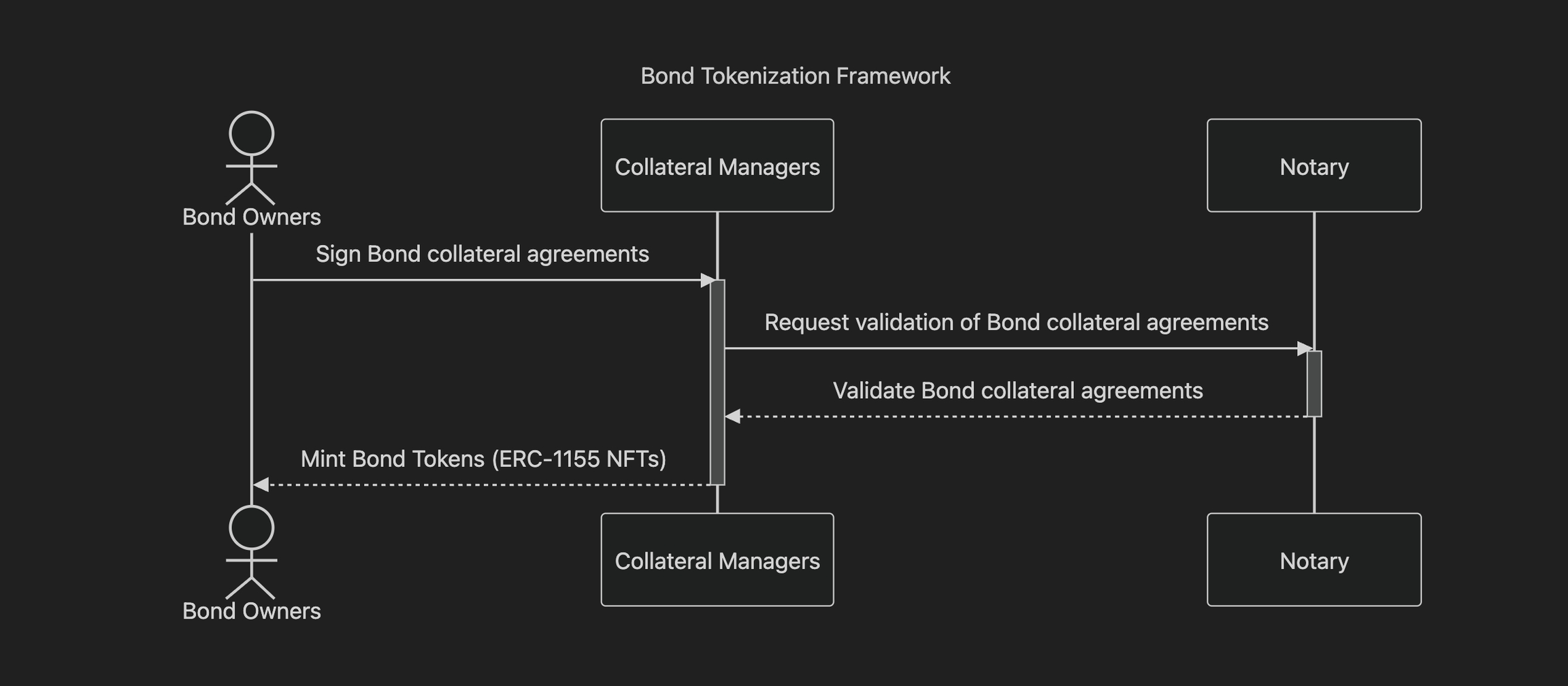
Bond Tokenization Framework C1
Actors:
- Bond Owners: entities or individuals who hold Bonds and tokenize them.
- Collateral Managers: entities who take Bonds into collateral and allow Bond Owners to mint corresponding Bond Tokens (via ERC-1155 NFTs).
- Notary: Validates Bonds collateral agreements and facilitates liquidation if needed.
Flow:
- Bond Owners → Collateral Managers: sign Bond collateral agreements.
- Collateral Managers → Notary: ask to validate Bond collateral agreements.
- Notary → Collateral Managers: validate Bond collateral agreements.
- Collateral Managers → Bond Owners: mint Bond Tokens (ERC-1155 NFTs).
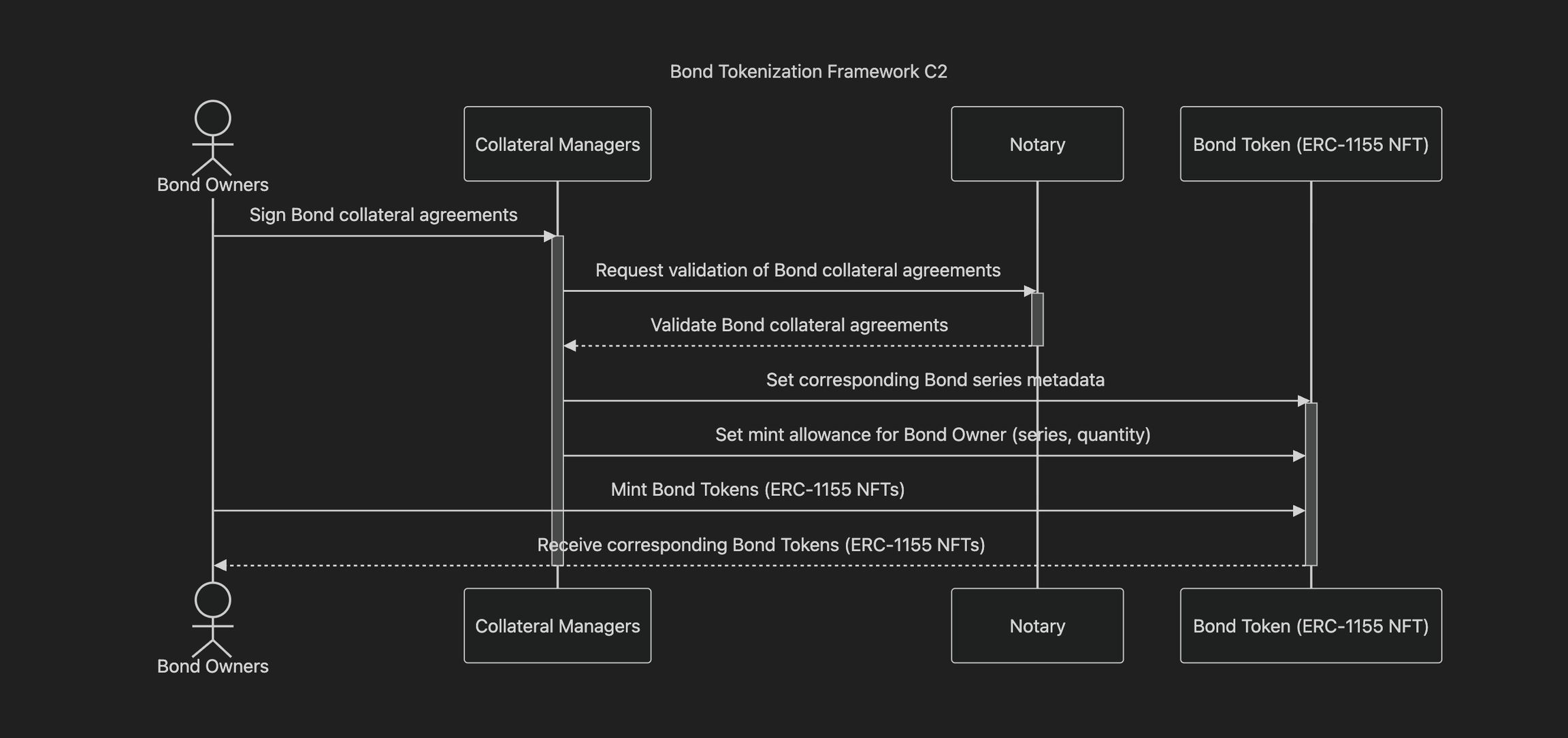
Bond Tokenization Framework C2
Actors:
- Bond Owners: entities or individuals who hold Bonds and tokenize them.
- Collateral Managers: entities who take Bonds into collateral and allow Bond Owners to mint corresponding Bond Tokens (via ERC-1155 NFTs).
- Notary: Validates Bonds collateral agreements and facilitates liquidation if needed.
- Bond Token: ERC-1155 NFT smart contract with custom metadata for each Bond series.
- Attestors: Independent entities responsible for periodically verifying the collateral held by each Collateral Manager.
Flow:
- Bond Owners → Collateral Managers: sign Bond collateral agreements.
- Collateral Managers → Notary: ask to validate Bond collateral agreements.
- Notary → Collateral Managers: validate Bond collateral agreements.
- Collateral Managers → Bond Token: set corresponding Bond series metadata in ERC-1155 NFT.
- Collateral Managers → Bond Token: set mint allowance for Bond Owner for a specified Bond series and quantity.
- Bond Owners → Bond Token: mint Bond Tokens (ERC-1155 NFTs).
- Bond Token → Bond Owners: receive corresponding Bond Tokens (ERC-1155 NFTs).
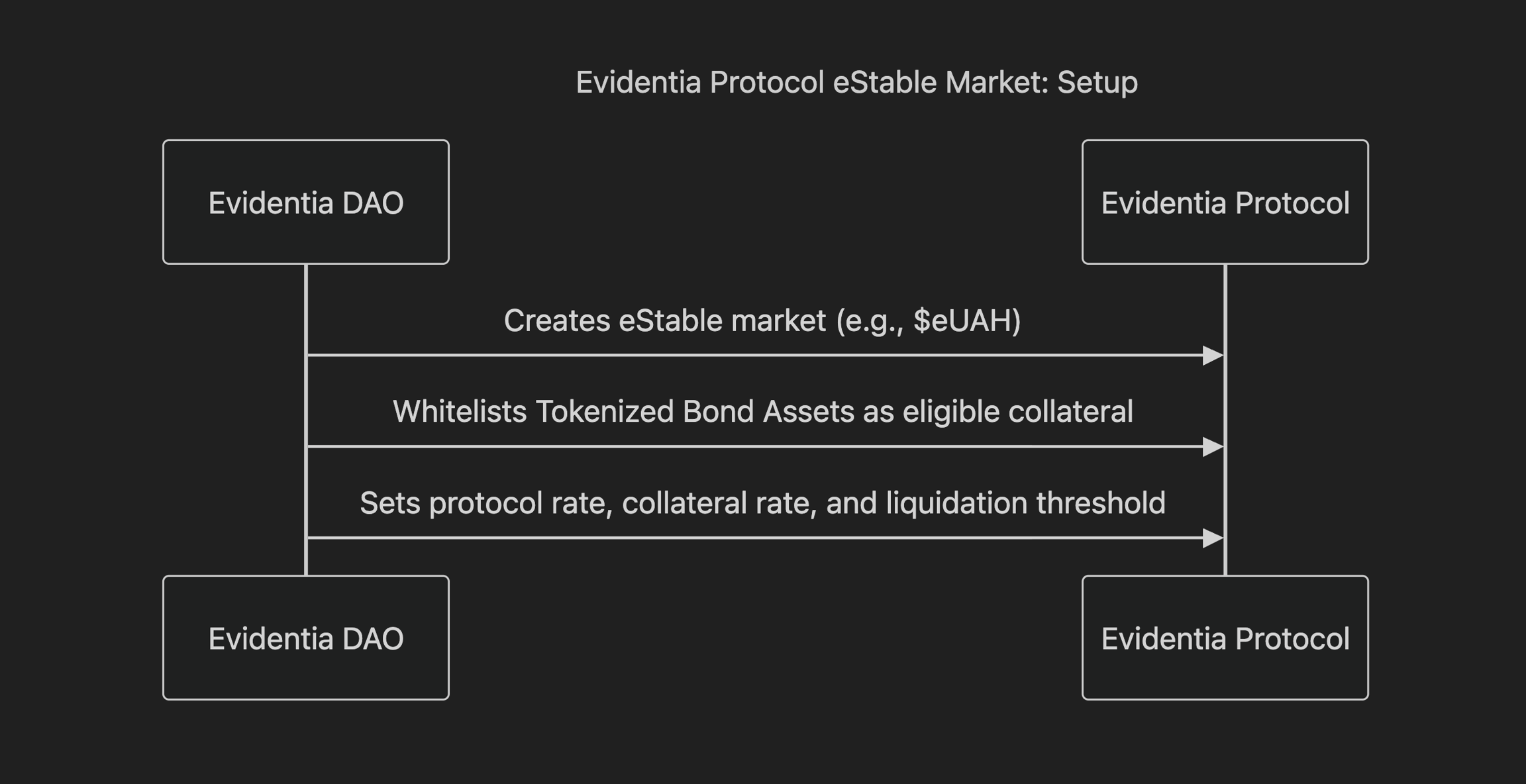
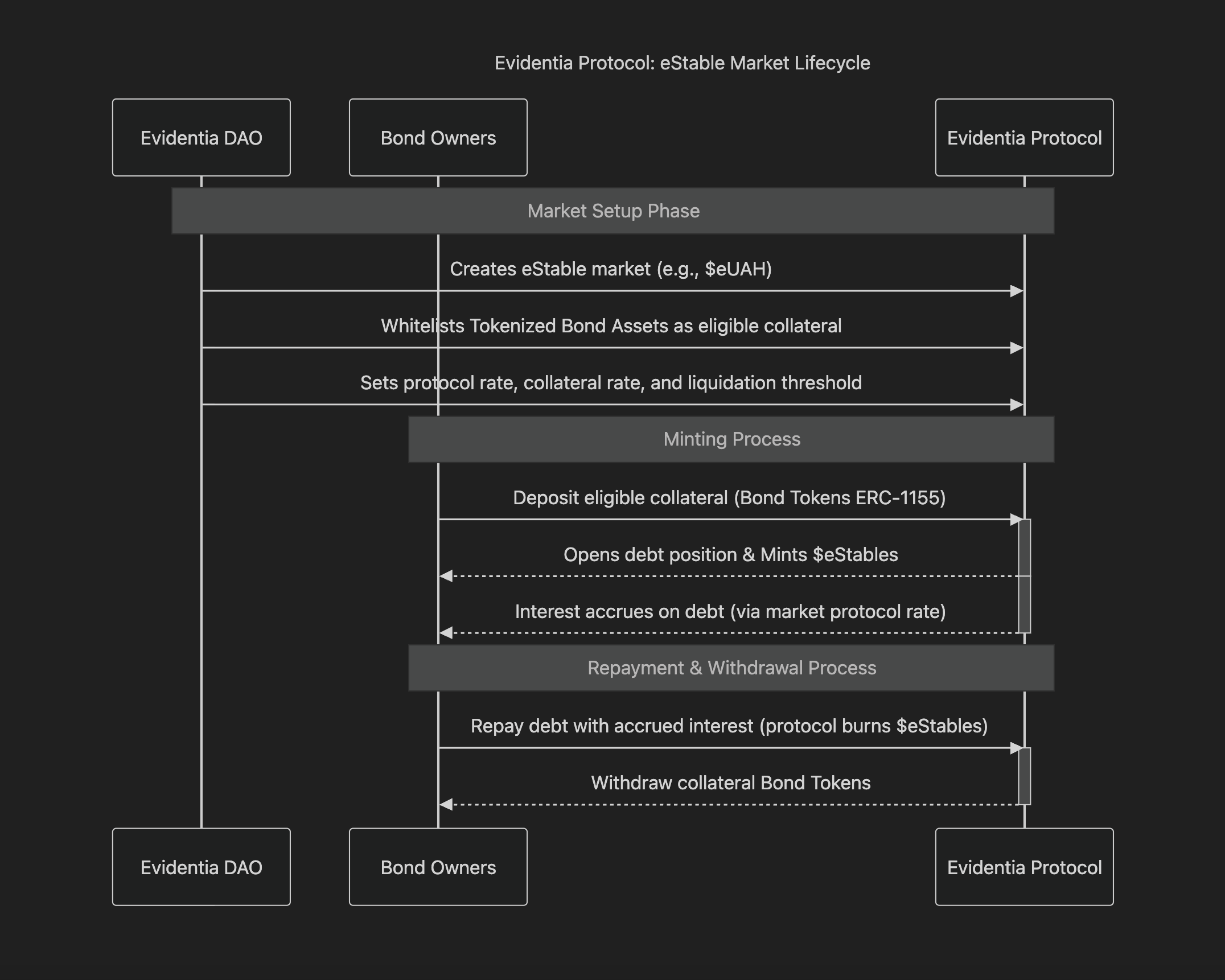
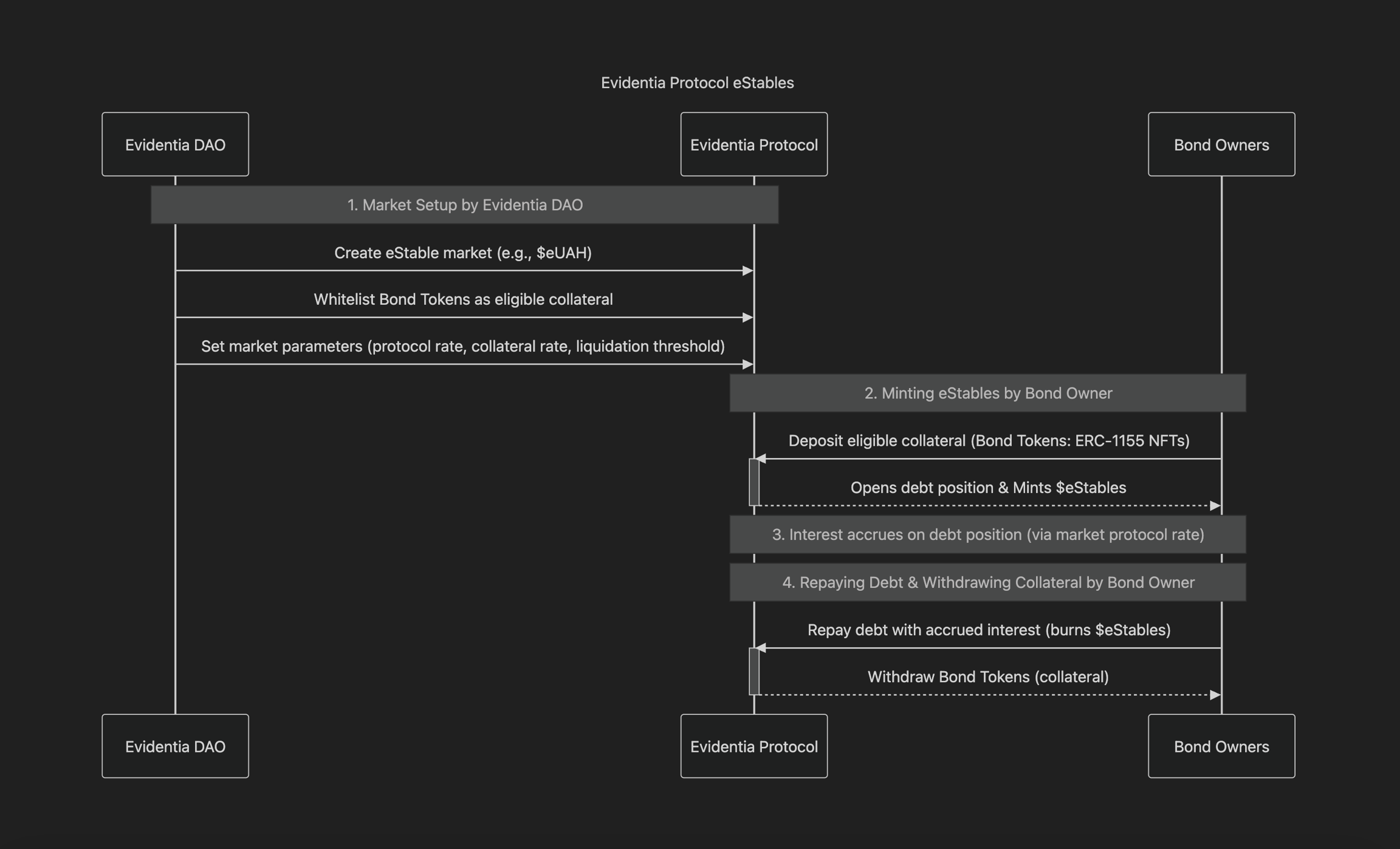
Evidentia Protocol eStable Market Setup
eStable Market: Mint & Burn
Actors:
- Evidentia Protocol: permissionless CDP stablecoin platform.
- Evidentia DAO: decentralized governance protocol that operates Evidentia Protocol.
- Bond Tokens: ERC-1155 NFT smart contract with custom metadata for each Bond series.
Flow:
- Evidentia DAO → Evidentia Protocol: creates eStable market (like $UAHe).
- Evidentia DAO → Evidentia Protocol: whitelist Tokenized Bond Assets as eligible collateral for eStable market.
- Evidentia DAO → Evidentia Protocol: sets protocol rate, collateral rate and liquidation threshold for eStable market.
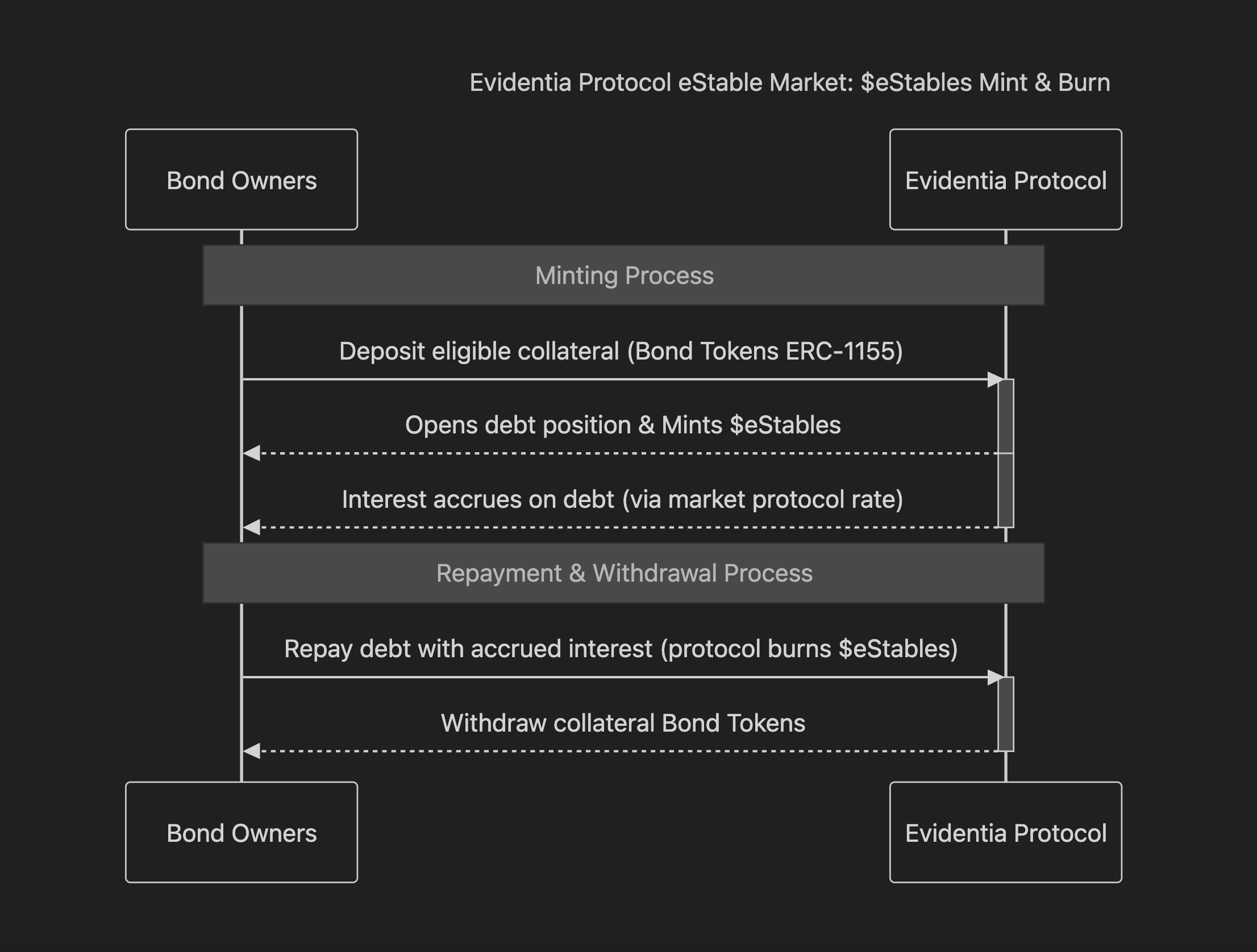
Evidentia Protocol eStable Market: Mint & Burn
Actors:
- Bond Owners: tokenized Bonds holders (holders of corresponding ERC-1155 NFTs).
- Evidentia Protocol: permissionless CDP stablecoin platform.
- Evidentia DAO: decentralized governance protocol that operates Evidentia Protocol.
- Bond Tokens: ERC-1155 NFT smart contract with custom metadata for each Bond series.
Flow:
- Bond Owners → Evidentia Protocol: deposit eligible collateral (Bond Tokens) to eStable market.
- Evidentia Protocol → Bond Owner: opens debt position and mints $eStables.
- Evidentia Protocol → Bond Owner: accrue interest via market protocol rate.
- Bond Owner → Evidentia Protocol: repays debt with accrued interest (and then burns $eStables).
- Evidentia Protocol → Bond Owner: withdraw collateral Bond Tokens.
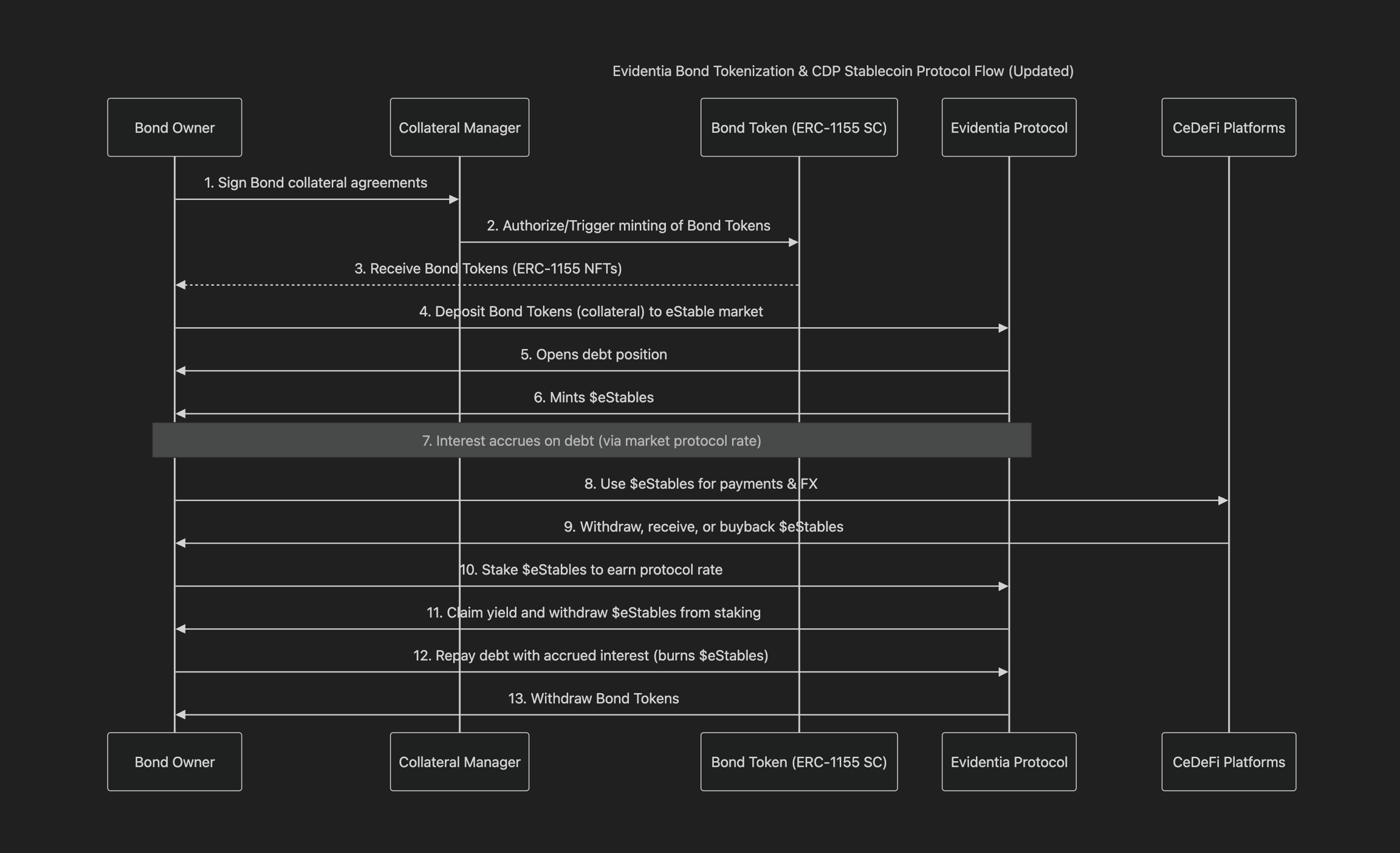
High-level Diagram: Evidentia Bond Tokenization Framework and CDP Stablecoin Protocol
Actors:
- Bond Owners: entities or individuals who hold Bonds and tokenize them.
- Collateral Managers: entities who take Bonds into collateral and allow Bond Owners to mint corresponding Bond Tokens (via ERC-1155 NFTs).
- Notary: Validates Bonds collateral agreements and facilitates liquidation if needed.
- Bond Token: ERC-1155 NFT smart contract with custom metadata for each Bond series.
- Evidentia Protocol: permissionless CDP stablecoin platform.
- Evidentia DAO: decentralized governance protocol that operates Evidentia Protocol.
Flow:
- Bond Owners → Collateral Managers: sign Bond collateral agreements.
- Collateral Managers → Bond Owners: receive corresponding Bond Tokens (ERC-1155 NFTs).
- Bond Owners → Evidentia Protocol: deposit eligible collateral (Bond Tokens) to eStable market.
- Evidentia Protocol → Bond Owners: opens debt position and mints $eStables.
- Evidentia Protocol → Bond Owners: accrue interest via market protocol rate.
- Bond Owners → CeDeFi: use $eStables for payments and FX purposes.
- Bond Owners → Evidentia Protocol: stake $eStables to earn protocol rate.
- Bond Owners → Evidentia Protocol: repays debt with accrued interest (burn eStables).
- Evidentia Protocol → Bond Owner: withdraw Bond Tokens.
- Bond Owners → Collateral Managers: return/burn Bond Tokens according to signed collateral agreement.
- Collateral Managers → Bond Owners: withdraw Bonds from collateral.
Examples
Example 1: User Tokenizes Bond, Receives a Loan, Repays Debt, and Receives Bond Back
1. Bond Tokenization and Loan Issuance
Bond Details:
- Issued Date: 01/01/2023
- Maturity Date: 01/01/2025
- Nominal Value: 100,000 USD
- Coupon Rate: 5% annually
- Next Coupon Payment: 01/01/2024
- Final Coupon Payment: 01/01/2025 (at maturity)
- Market Price at Tokenization (01/01/2023): 100,000 USD
Loan Calculation:
- Safety Fee: 5%
- Platform APY: 12%
- Max Loan Amount:
(100,000 + 100,000 × 5%) × (1 − 5%) = 105,000 × 0.95 = 99,750 stablecoins - Loan Issued: 99,750 stablecoins
2. Debt Repayment and Bond Retrieval
Interest Accrued Over 12 Months (APY 12%):
- Daily interest rate = (1 + 12%)1/365 − 1 ≈ 0.0310538%
Debt Repayment:
- User repays a maximum of 99,750 stablecoins (principal + interest) in the final case, when repayment is made on the last day of bond maturity.
- In the normal case, 45 days prior to maturity, the maximum debt would be 98,045.93 stablecoins.
- User retrieves the bond from the platform.
Outcome: The user repays the debt with interest and retrieves the bond, allowing them to benefit from the bond's final coupon payment and nominal value at maturity.
Example 2: User Tokenizes Bond, Receives a Loan, Adds New Bonds as Collateral Before Maturity, and Keeps Position
1. Bond Tokenization and Loan Issuance
Bond Details:
- Issued Date: 01/01/2023
- Maturity Date: 01/01/2025
- Nominal Value: 100,000 USD
- Coupon Rate: 5% annually
- Next Coupon Payment: 01/06/2023
- Final Coupon Payment: 01/01/2025 (at maturity)
- Market Price at Tokenization (01/01/2023): 100,000 USD
Loan Calculation:
- Safety Fee: 5%
- Platform APY: 12%, daily APY 0.0310538%
- Max Loan Amount: 99,750 stablecoins (same as in Example 1)
- Usable loan amount at date of tokenization (01/01/2023): 79,495.40296 = 99,750 / ((1 + 0.0310538%)731)
2. Bond Maturity Approaching and Collateral Addition
Loan Status on 11/01/2024 (2 months before maturity):
- Maximum outstanding debt with accrued interest = 99,750 / (1 + 0.0310538%)61 ≈ 99,750 / 1.01912036 = 97,878.52738 stablecoins
- Actual user debt: 39,000 stablecoins
New Bond Details for Collateral Addition:
- Issued Date: 11/01/2024
- Maturity Date: 11/01/2026
- Nominal Value: 50,000 USD
- Coupon Rate: 5% annually
Updated Loan Calculation:
- New max loan amount with additional collateral = (100,000 + 50,000) × 1.05 × 0.95 ≈ 99,750 + 49,875 = 149,625 stablecoins
- New available total debt amount from total collateral = 97,878.52738 + 49,875 / (1 + 0.0310538%)730 = 97,878.52738 + 39,760.04464 = 137,638.572 stablecoins
- The user's position is safe, and no liquidation occurs.
Updated Loan Calculation on 11/17/2024 (45 days until maturity of first collateral):
- Available amount from new collateral on 11/17/2024 = 49,875 / (1 + 0.0310538%)714 = 39,958.05734 stablecoins
- Available amount from old collateral on 11/17/2024 = 0 (as maturity date is less than 45 days away)
- User debt position: 39,000 × (1 + 0.0310538%)16 = 39,194.22768 stablecoins
3. Position Continuation
- User retains the position, and the original bond matures on 01/01/2025.
- As 39,194.23 < 39,958.05734, the user's debt is collateralized with the new collateral, and the old collateral is free for withdrawal.
- When collateral is withdrawn, preminted 99,750 stablecoins are burned.
Outcome: The user avoids liquidation by adding new collateral and continues to benefit from the bond's final payout.
Example 2-1: User Tokenizes Bond, Receives a Loan, Adds New Bonds as Collateral Before Maturity, and Keeps Position After Partial Liquidation
All data used from Example 2, but the user's actual loan is larger and not fully covered by new collateral.
1. Bond Tokenization and Loan Issuance
Bond Details:
- Issued Date: 01/01/2023
- Maturity Date: 01/01/2025
- Nominal Value: 100,000 USD
- Coupon Rate: 5% annually
- Next Coupon Payment: 01/06/2024
- Final Coupon Payment: 01/01/2025 (at maturity)
- Market Price at Tokenization (01/01/2023): 100,000 USD
Loan Calculation:
- Safety Fee: 5%
- Platform APY: 12%, daily APY 0.0310538%
- Max Loan Amount: 99,750 stablecoins
- Usable loan amount at date of tokenization: 79,495.40296
2. Bond Maturity Approaching and Collateral Addition
Loan Status on 11/01/2024 (2 months before maturity):
- Maximum outstanding debt with accrued interest = 97,878.52738 stablecoins
- Actual user debt: 60,000 stablecoins
Updated Loan Calculation on 11/17/2024:
- Available amount from new collateral = 39,958.05734 stablecoins
- Available amount from old collateral = 0 (maturity less than 45 days away)
- User debt position: 60,000 × (1 + 0.0310538%)16 = 60,298.81181 stablecoins
- Debt of 60,298.81181 − 39,958.05734 = 20,340.75447 stablecoins is covered by old bond collateral.
- Max amount of this debt with interest until maturity = 20,340.75447 × (1 + 0.0310538%)45 = 20,626.95107 stablecoins
- Collateral value to cover this debt with safety fee = 20,626.95107 / (1 − 5%) = 21,712.58 stablecoins
- Bonds nominal with 5% coupon to be liquidated = 21,712.58 / (1 + 5%) = 20,678.65. At 1,000 nominal per bond, 21,000 bonds nominal should be available for liquidation.
- As 21,000 bonds are liquidated, premint of 20,947.5 = (21,000 + 21,000 × 5%) × (1 − 5%) stablecoins are burned.
- When 79,000 bonds are withdrawn from collateral, premint of 78,802.5 stablecoins are burned.
3. Position Continuation
- As 60,298.81181 > 39,958.05734, the user's debt is undercollateralized, triggering partial liquidation of 21,000 of old bonds.
- 79,000 old bonds can be withdrawn.
Outcome: The user's collateral is subject to partial liquidation. By adding new collateral, the user continues to benefit from the final payout of the remaining bonds. 21,000 bonds are liquidated and transferred to the liquidator.
Example 3: User Tokenizes Bond, Receives a Loan, and Gets Liquidated Due to Inaction
1. Bond Tokenization and Loan Issuance
Bond Details:
- Issued Date: 01/01/2023
- Maturity Date: 01/01/2025
- Nominal Value: 100,000 USD
- Coupon Rate: 5% annually
- Next Coupon Payment: 01/01/2024
- Final Coupon Payment: 01/01/2025 (at maturity)
- Market Price at Tokenization: 100,000 USD
Loan Calculation:
- Safety Fee: 5%
- Platform APY: 12%
- Max Loan Amount: 99,750 stablecoins
2. Coupon Payment on 01/01/2024
- User fails to add collateral after the coupon payment.
- Coupon payment reduces the bond's value as it approaches maturity.
3. Liquidation on 07/17/2024
- Outstanding Debt: 99,750 stablecoins
- Bond Value with Last Coupon (45 days before maturity):
- Bond nominal: 100,000 stablecoins
- Last coupon: 5,000 stablecoins
- Total bond value: 105,000 stablecoins
Liquidation Process:
- Liquidator steps in and covers the outstanding debt of 99,750 stablecoins.
- Liquidator receives the bond worth 105,000 stablecoins at maturity.
- Liquidator's profit = 105,000 − 99,750 = 5,250 stablecoins
Outcome: The user loses the bond, and the liquidator profits from the bond's maturity payout.
Use Cases for Local Stablecoins
Stablecoins have emerged as a cornerstone of decentralized finance (DeFi), offering price stability in an otherwise volatile crypto ecosystem. The Evidentia Protocol introduces a novel approach by enabling the creation of local stablecoins — synthetic assets pegged to local currencies and backed by tokenized government bonds. These stablecoins unlock liquidity for bondholders while providing practical utility across various sectors. This paper explores key use cases for local stablecoins and articulates their significance in bridging traditional finance and decentralized ecosystems.
Use Cases for Local Stablecoins
1. Local Currency Exchange Providers
- Use Case: Local stablecoins enable cashless transactions in regions where traditional banking infrastructure is limited or costly. Exchange providers can facilitate seamless conversions between fiat and stablecoins, supporting digital wallets and peer-to-peer payments.
- Example: In a rural area with unreliable banking, users convert tokenized bond-backed stablecoins into local currency equivalents for daily purchases.
2. Loyalty Program Providers
- Use Case: Businesses can tokenize customer rewards into yield-bearing stablecoins, enhancing loyalty programs. These stablecoins, backed by bond collateral, accrue value over time via staking yields, incentivizing retention.
- Example: A retailer issues stablecoin rewards that customers stake within Evidentia's pool, earning a share of borrower interest.
3. SMEs in Volatile Markets
- Use Case: Small and medium enterprises (SMEs) in regions with unstable local currencies can use stablecoins to hedge against inflation and currency depreciation, ensuring predictable cash flows.
- Example: An SME in a hyperinflationary economy locks bond collateral to mint stablecoins, preserving purchasing power for inventory purchases.
4. Remittance Services
- Use Case: Local stablecoins enable low-cost, instant cross-border payments, bypassing traditional remittance fees and delays. Recipients can redeem stablecoins for local currency or use them directly.
- Example: A worker abroad sends stablecoins to family, who convert them to local currency via an exchange provider at minimal cost.
5. DeFi Protocols
- Use Case: Integration of local stablecoins into DeFi platforms allows users to leverage them as yield-bearing assets in lending, borrowing, or liquidity pools, expanding their utility beyond simple transactions.
- Example: A DeFi protocol uses Evidentia's stablecoins as collateral for lending, offering users bond-derived yields.
6. Microfinance Institutions
- Use Case: Microfinance providers can issue microloans in stablecoins backed by bond yields, offering affordable credit to underserved populations while generating returns for lenders.
- Example: A microfinance institution mints stablecoins to fund small loans, with repayments supplemented by staking profits.
7. E-Commerce Platforms
- Use Case: Online retailers can accept payments in local stablecoins, providing customers with a stable, blockchain-based alternative to fiat, especially in regions with currency volatility.
- Example: An e-commerce site in a volatile market accepts stablecoin payments, reducing exchange rate risks for both buyer and seller.
Importance of Local Stablecoins
Economic Empowerment
Local stablecoins democratize access to stable, yield-bearing assets, enabling individuals and businesses to participate in global finance without relying on centralized intermediaries. This is particularly impactful in emerging markets where traditional options are scarce.
Stability and Trust
Unlike volatile cryptocurrencies, local stablecoins inherit the credibility of government bonds, ensuring user confidence. The Evidentia Protocol's transparent liquidation and staking mechanisms further reinforce trust, making these assets a dependable alternative to fiat.
Innovation in Yield Generation
By tying stablecoins to bond yields and staking pools, Evidentia transforms static financial instruments into dynamic tools for wealth creation. This innovation aligns with DeFi's ethos of maximizing capital efficiency while maintaining stability.
Mainnet
Markets
Authorized Collateral Managers
Sepolia Testnet
Security Audit
Evidentia Smart Contracts — Security Audit Report
- Engagement type: Comprehensive design and code assessment (upgradeability, economic safety, access control)
- Auditor: Independent Crypto / Blockchain Security Researcher
- Report date: 20 August 2025
Outcome
No vulnerabilities (Critical, High, or Medium) were identified within scope.
Engineering quality: Clear, modular, and consistent — aligned with recognized upgradable-contract standards.
Scope
src/BondNFT.sol— ERC-1155 upgradable bond series with per-user mint allowances and metadatasrc/StableBondCoins.sol— ERC-20 upgradable stable token with MINTER_ROLE, ERC20Permitsrc/StableCoinsStaking.sol— staking and rewards for stablecoins; upgradable; role-gated upgradessrc/NFTStakingAndBorrowing.sol— stake ERC-1155 bond NFTs and borrow stablecoins; PRBMath fixed-pointsrc/StableOFTAdapter.sol— LayerZero OFT adapter for omnichain transferssrc/V2/*— evolutionary versions mirroring the above architecture
Findings Summary
Key Engineering Highlights
- ERC-7201 namespaced storage across all upgradable contracts
- UUPS upgradeability with narrowly scoped authorizers
- OpenZeppelin Upgradable suite (Ownable, AccessControl, ERC1155/20, ReentrancyGuard, UUPS)
- PRBMath UD60x18 for precise interest and discounting math
- LayerZero OFT adapter for omnichain transfers
- Access controls are explicit and minimally permissive; state transitions are consistently evented
User Guide
Evidentia User Guide
Welcome to Evidentia — the decentralized protocol for tokenized bonds and eStablecoins issuance. This guide will walk you through the main features available in the platform's interface.
Dashboard
The Dashboard provides a comprehensive overview of the Evidentia ecosystem, including key metrics, historical performance, and bond data.
Counters
- Circulating Supply: Total amount of tokenized bonds exchanged for UAHe.
- Staking APR: Annualized percentage return for staking UAHe.
- Amount Staked: Total UAHe currently staked.
- Total UAHe Holders: Number of unique wallet addresses holding UAHe.
- Total Asset Issuers: Number of users who have staked UAHe.
- Total Bonds in Collateral: Total value of tokenized bonds used as collateral.
Charts
- Supply History Chart: Tracks historical changes in circulating UAHe.
- Staking APY History: Visualizes changes in staking APR over time.
Bonds List Table
- Columns: ISIN, Country, Currency, Principal, In Collateral, Maturity.
Staking
The Staking page allows you to stake and unstake your UAHe tokens, view rewards, and track your staking history.
Stake UAHe
- Input Field: Enter the amount of UAHe to stake.
- "MAX" Button: Autofills your wallet's maximum available UAHe.
Unstake UAHe
- Input Field: Enter the amount of UAHe to unstake.
- "MAX" Button: Autofills the amount of staked UAHe you have.
Staking APY Counter
- Staking APY: Displays the current yield from staking UAHe.
Staking Stats
- Total Staked: Overall amount of UAHe staked across the platform.
- Your Staked: Your personal staking amount.
- Rewards: Your accrued rewards.
- "Claim Rewards" Button: Transfers rewards to your wallet.
Staking APY History Chart
- Visual representation of how the APR has evolved over time.
Staking History Table
- Title: Staking History
- Columns: Date, Type (Stake/Unstake), Amount (UAH)
- Navigation: Previous / Next buttons and pagination footer.
Feel free to explore each page of the app and manage your UAHe and tokenized bond positions with full transparency and control.
Issuer Guide
Mint
Use the Mint page to mint new UAHe tokens by collateralizing tokenized bonds.
1. Mint Section
- Input Field: Enter the amount of UAHe to mint.
- "Mint" Button: Mints tokens after you've collateralized bonds.
2. Debt Position Section
Displays current borrowing data:
- Total Minted: Total amount of UAHe you've minted.
- Accrued Interest: Interest accumulated on your debt.
- Interest Rate: Rate applied to your mint position.
- "Repay" Button: Opens a repayment pop-up to reduce debt.
3. Bonds Section
Two tabs: Owned & Collateralized and Bonds List
Owned & Collateralized Tab
- Owned Bonds Table: ISIN, Country, Currency, Principal, Maturity, Number, Collateral Value. Action: "Supply"
- Collateralized Bonds Table: Same columns. Action: "Withdraw"
Bonds List Tab
- Columns: ISIN, Country, Currency, Principal, In Collateral, Maturity.
4. History Table
- Columns: Date, Type, Amount, ISIN.
Feel free to explore each page of the app and manage your UAHe and tokenized bond positions with full transparency and control.